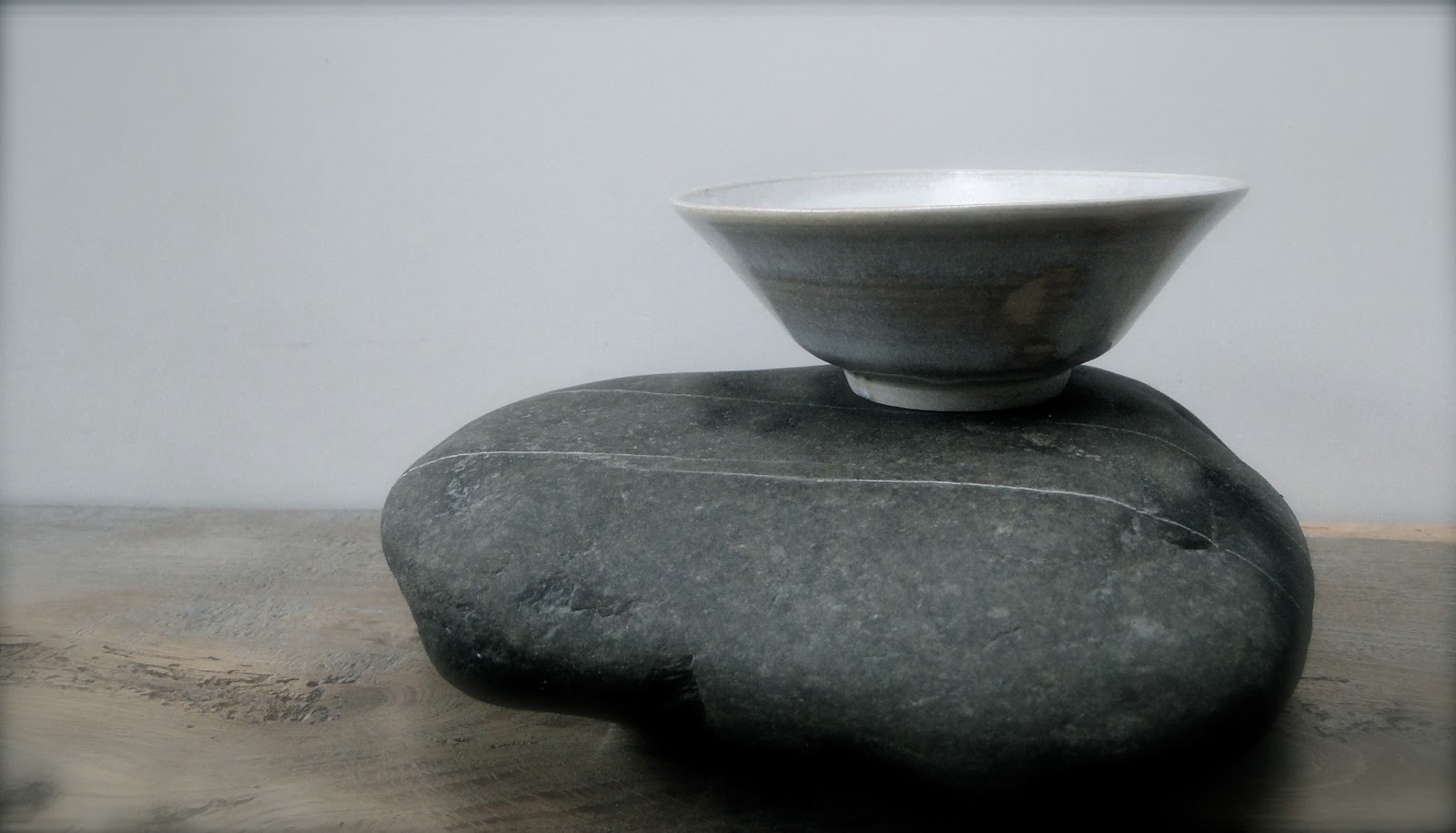
05/06/2013

WIND

The teaist Soshitsu Sen XV wrote in his book ‘Tea Life, Tea Mind’:

“our spirit should flow through life like the wind that flows through all of nature.”

Always in motion and at the same time approaches a sublime state of tranquillity, that’s an aesthetic concept unique to tea.

When I holding a tea bowl, I open my hands and my heart, and for a moment I feel a little rest through the chaos around me and in me.

Today I’ve brewed a Nepalese green tea, Mao Feng: a tender green cup of tea, where the sun is reflected and where I detect a subtle earthy taste.

Years ago when I travelled through Nepal, my knowledge about tea was limited to a few teas in bags. Nowadays I travel through the flavours of many real teas and each time the taste brings me a little closer to the world and to myself.

It feels like it is just the beginning.
 Photo’s and teabowl: Iris Weichler

16/05/2013

-->
STAMPS


The colours of the flowers of last summer are gone. What remains are seedpods, which can very well be used as stamps to decorate clay object. This I have done with my yunomi’s. A yunomi is a teacup made for daily or informal Japanese tea drinking. In contrast to a chawan, a teabowl which is used during the Japanese tea ceremony, a yunomi is taller than wide.


A potter once said: ‘Yunomi can be used by anyone, regardless of age, and it is also the last item removed from the dining table. It is there at our sides for many hours during the day and brings us comfort’ (Robert Yellin)


I prepared kukicha, a very balanced and tender Japanese green tea, made of twigs, stems and stalks of the tea plant. Because of the naturally low caffeine content, you can drink it at any time of the day.


My hands print the lost beauty of flowers to remember. The tea keeps it warm in my memory.


Photo’s, yunomi and presentation vessel (stoneware): Iris Weichler

02/05/2013


WHITE


When our cherry tree begins to sing because the white blossoms lure hundreds of buzzing bees, than spring invites me to brew a clear and pure tea, to celebrate the awakening of nature.


How could it be otherwise that I choose a white tea with fine, downy leafs: for example, Pai Mu Tan from  the mountains of Fujian, China. 
White tea gets its name from the fine silvery white hairs on the unopened buds of the tea plant. It’s the least processed form of tea, made of select leaves which have been steamed and dried.


The legend tells us that Qin Shihuangdi, the first Emperor of China (259-210 BC), believed that white tea was an essential ingredient of the elixir of life, which makes him immortal. He commands to collect the fragile tea leafs only by virgins who have to use golden scissors for it. No one should touch the leafs after the harvest, except himself, for brewing the tea. 
Unfortunatly, he died when he was 49 years old, despite to have the privilege to drink this extraordinary tea.

Nowadays, it is still a privilege to drink white tea. Although, everyone can drink it, not only the emperor and meanwhile we know that it promises us not the infinite life, it’s always a special experience to enjoy its delicate taste.


To brew this Pai Mu Tan, I use a gaiwan.  It’s a Chinese tea bowl, invented during the Ming Dynasty (1368-1644) and consists of a saucer, a cup and a lid. 
After rinse the gaiwan with hot water, I fill the dry tea leafs into the cup, fill again with hot water (80°C) and let the tea infuse for 4 min. It’s possible to drink directly from the gaiwan, but I have poured the tea into a serving pitcher and than into a tasting cup.


My eyes are blinded by the sight of so many blossoms, the taste of tea let me see the beauty of it.


Photo’s, gaiwan, teacup (stoneware): Iris Weichler

17/04/2013

--> 
MOSS

It’s 9 o’clock in the morning. The temperature outside is pleasant, birds chirping excitedly, there is a smell of damp moss in the air, gently let the garden itself stroking by the first rays of sun. 
There are no guests, the children are back to school after two weeks Easter holidays. 

Just me and my tea...

It is the perfect condition to drink a fresh and fruity tasting green tea from South- Korea, Seogwang.


In Korea, people use simple tea sets, often in white porcelain, for not disturbing the concentration and to let the colour of the tea nice come true. 
They like to have tea ceremony as a way of self- reflection and meditation.


I use an unglazed kyusu (teapot with side handle), and a little teacup, just decorated with a little slip.


While I sip of my tea, I flatter my mind carefully down on the moss. Here on this little piece of nature begins the wonder.


Photo’s, kyusu and teacup (stoneware): Iris Weichler

03/04/2013


FIRE


Drinking tea is always a bit of travel.


Searching for inspiring colour palettes, intensive smells and aromatic tastes, I will enjoy the moment that I can be part of a scene where all my senses can be challenged.


So today I go through a handful of Indian charm and brew a Masala Chai. I’ve chosen for a black Indian tea from the gardens of Nelliyampathy (Kerala, South India). In combination with spices and creamy milk, this tea warms up my whole body and soul.


The ingredients for Masala chai:
Black Indian tea, whole cloves, cardamom pods, cinnamon stick, fresh ginger, black pepper balls, star anise (the spices must be prepared in a mortar), milk (foam) and optional: sugar or rice syrup.
 
The round shape of the teabowls fits right in the hands, so that they also comfortably warm up


The flames of the fire licking at the time. There is tea now. Let’s not think about tomorrow.


Photo’s, black earthenware and white milk pitcher: Iris Weichler

20/03/2013

-->
PATIENCE


Spring is not yet in the air here in Belgium. This long winter has one advantage: during cold and wet days, I had the opportunity to make a lot of teaware.  It is a long way from clay to an useful teapot, but finally, today I can brew a Japanese Sencha in my ‘kyusu’.


A kyusu is a traditional Japanese teapot, often with a side handle. This handle must have the right angle to pour comfortable. I show a small sized kyusu about 150ml, used for high grade Japanese green tea, such as Sencha. After picked, the tealeaves of Sencha are steamed, rubbed and then dried. A good Sencha smells of fresh green grass.

I long for this smell, I long for spring. Fortunately, I can drink tea and wait ….


Patience is a virtue.

Photo's, kyusu, teacups and presentation vessel (stoneware): Iris Weichler


05/02/2013


RAINDROPS

It’s raining here all the time. The best way to give me a good feeling at this moment is to make a cup of Longjing, served in my favourite tea bowl.

Longjing or Dragon Well tea is a first class green tea from Hanzhou, China. The infusion of the tight, flat shaped, light green leaves gives me an intensive taste reminiscent of roasted chestnut.

The shape of one of my first tea bowls I’ve made, is inspired by the Chinese tea bowls of the early 11th and 12th century, typically for Jian ware, made in Fujian province. These tea bowls however were covered with a thick, very dark glaze (coloured with iron oxide) and especially used by Chan (Zen) Buddhist monks in the Fujian region.


Raindrops balance my wisteria in its sleep. Tea quiets the dragons in my head.
Photo's and tea bowl: Iris Weichler